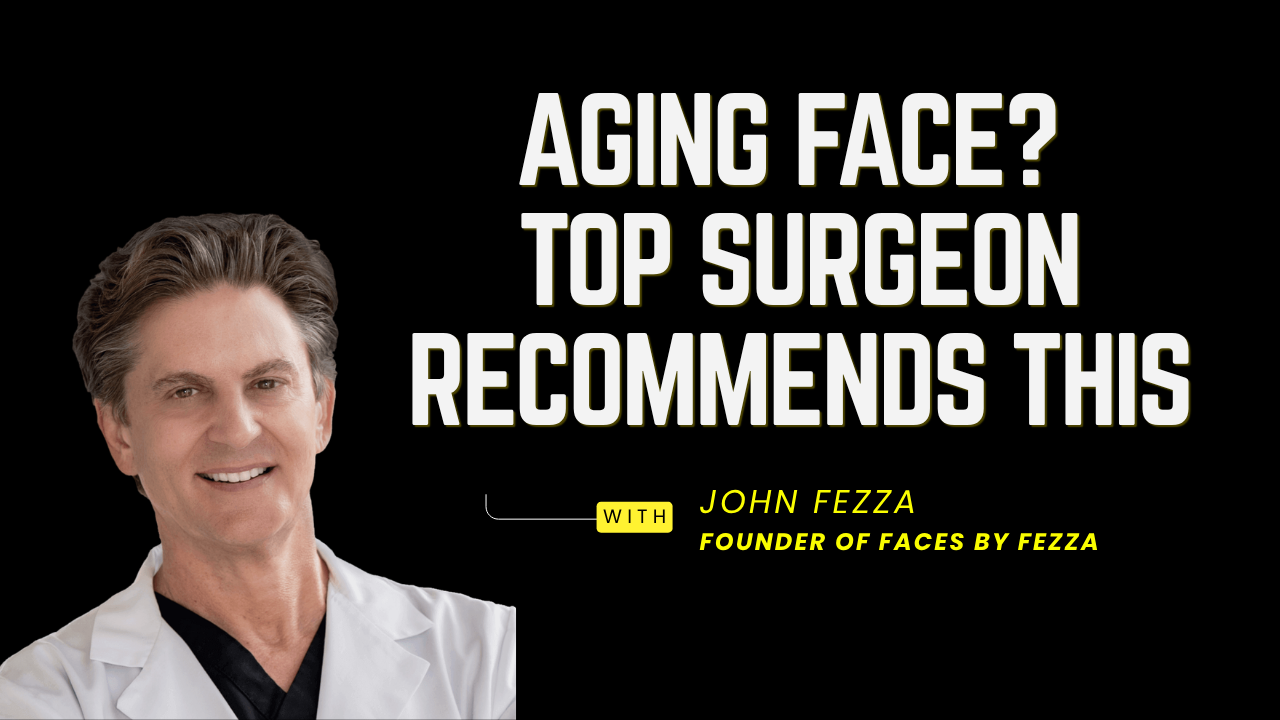
You’ve been told that wanting to look good is shallow. That the goal, as you age, is to accept the sagging skin, the tired reflection, the sense of not quite recognizing yourself anymore — quietly, gracefully, without complaint. But what if that advice has it backwards? What if the real problem isn’t wanting to look like yourself again, but a healthcare system that never taught you how your body actually ages, or that how you feel about your reflection has real, measurable effects on how you move through the world?
I sat down with Dr. John Fezza, a facial plastic surgeon with over 30 years of experience and Director of Cosmetic Services at Center for Sight in Sarasota, to talk about something we rarely discuss honestly: the connection between how we age, how we feel about it, and why the decision to intervene — surgically or not — is almost never just about vanity. Watch our full conversation below.
The Mistakes Most People Make
The first mistake is assuming any interest in cosmetic intervention is inherently vain or unhealthy. Dr. Fezza was direct about this: wanting to look like the best version of yourself, at any age, is not the same as chasing an unrealistic ideal.
The second mistake is confusing realistic goals with unrealistic ones. He described patients who come in wanting to look 20 at 80 — that’s not a goal a good clinician will support. But patients who bring in a photo from their thirties and want to restore specific features they recognize as themselves? That’s an entirely different, and achievable, conversation.
The third mistake, and one I see constantly in my own practice as a nutritionist working with midlife clients, is separating the physical and emotional sides of aging entirely — as though how your body composition changes has nothing to do with how your face ages, or as though addressing your appearance has nothing to do with your mental health. Dr. Fezza noted that the patients who heal fastest and feel best afterward are consistently the ones who came in already physically healthy — not as a coincidence, but because a strong, well-nourished body handles both the physical and emotional demands of change far better.
Bonni's Clinical Recommendations

Here is what I actually tell my clients navigating this stage of life, informed by both my clinical experience and this conversation.
First, understand that your body composition — not just your weight — directly affects how you age, in your face and everywhere else. Preserving muscle mass protects bone density, and bone density is part of what gives your face its structure over time. This is precisely why body composition, not the number on the scale, is the metric I track with clients through one on one nutrition coaching Sarasota.
Second, if you’re on a GLP-1 medication or considering one, know that facial volume loss is a common and predictable side effect of rapid weight loss — not a flaw in the medication, but a variable to plan for. Nutrition and resistance training during that process matter more than most people realize.
Third, whatever path you choose — nutrition, movement, injectables, or surgery — go in with realistic expectations and a genuinely healthy body. Dr. Fezza was candid that patients who are not medically optimized before a procedure don’t just risk worse outcomes; they risk not feeling the transformation they were hoping for at all.
Finally, take the emotional side seriously. If you’re considering a significant change to how you look, understand that identity and self-perception are legitimately part of the clinical picture — not a footnote to it. This is exactly the kind of whole-person thinking behind diet and nutrition counseling Sarasota clients trust me with, because lasting change has never been just physical.
Bonus Tips & FAQs

Is it healthy to care about how I look as I age? Yes. Dr. Fezza was direct on this point: wanting to feel good in your own reflection is not shallow. What’s unhealthy is a culture that tells you to simply accept decline without question.
Does cosmetic surgery actually change how people feel, or just how they look? Both, according to 30 years of clinical observation. Patients consistently report feeling less stressed, more confident, and treated differently by others — a psychological shift that reinforces itself over time.
Is there an emotional adjustment period after a procedure? Often, yes. Many patients experience a temporary low around 10 days post-procedure, before the more lasting positive shift sets in. This is a normal part of healing, not a sign anything went wrong.
How does GLP-1 weight loss factor into facial aging? Rapid fat loss often hits the face first, which can create a hollowed appearance even as the rest of the body reflects improved health. It’s manageable with the right nutritional strategy and, if desired, targeted volume restoration.
Key Takeaways

- How you feel about your reflection has real, observable effects on stress, confidence, and how others treat you — this isn’t vanity, it’s psychology.
- Facial aging is a structural process involving bone, muscle, and skin changes — not simply “gravity” or an unavoidable decline to accept quietly.
- Patients who are physically healthy going into any cosmetic intervention consistently report better outcomes, physically and emotionally.
- Muscle preservation protects bone density in the face as well as the body, making nutrition and resistance training part of any healthy aging strategy.
- Realistic expectations, not unrealistic ideals, are what separate a satisfying outcome from a disappointing one.
- Addressing how you look and addressing how you feel have never been separate goals — they’re the same goal, approached from two directions.
Get connected with John Fezza
Instagram: @FacesbyFezza
Facebook: Faces by Fezza
If you’re navigating this stage of life and want a strategy that supports your body, your confidence, and how you actually feel in the mirror, let’s talk about what that looks like for you.
Book My Free Discovery Call