You crossed 45, or 50, or 55, and something shifted. Your jeans fit differently. The afternoon crash arrives earlier. Your fasting glucose creeps up at every annual physical. And someone, maybe your doctor, maybe a friend, delivers the verdict: your metabolism slowed down, and you need to accept it.
I have heard that sentence from hundreds of clients over 27 years of clinical practice, and it is one of the most costly misconceptions in midlife health. It is also wrong. A landmark study of more than 6,400 people shows that your metabolism did not fall off a cliff at 45. Something else is going on, and that something else is fixable.
That distinction changes everything. A broken engine asks you to surrender. A neglected engine asks you to look under the hood.
In the video below, I walk through the five truths the research actually shows about metabolism in midlife, and the one thing that matters more than all five. Watch it, then come back here for the clinical detail and the exact steps I give my own clients.

Why This Actually Matters
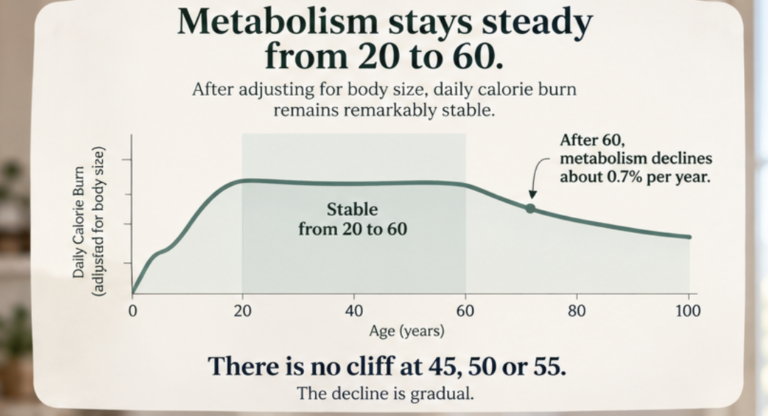
In 2021, the journal Science published one of the largest studies of human energy expenditure ever conducted. Researchers measured daily calorie burn in more than 6,400 people across 29 countries, from newborns to adults aged 95. After adjusting for body size, metabolism held remarkably steady from about age 20 to age 60. The decline that followed averaged roughly 0.7 percent per year. There was no cliff at 45, 50, or 55.
So why does midlife feel like a different body? Because several things change at once, and nearly all of them respond to your choices. Muscle mass declines. Sleep gets shorter and lighter. Stress accumulates. Food environments tilt toward convenience. Hormones shift in men and women alike, and those shifts change how your body handles blood sugar and where it stores fat, including the stubborn menopause belly fat that so many women ask me about. The engine is intact. The inputs changed.
So why does midlife feel like a different body? Because several things change at once, and nearly all of them respond to your choices. Muscle mass declines. Sleep gets shorter and lighter. Stress accumulates. Food environments tilt toward convenience. Hormones shift in men and women alike, and those shifts change how your body handles blood sugar and where it stores fat, including the stubborn menopause belly fat that so many women ask me about. The engine is intact. The inputs changed.
Here is the number that should reframe how you think about all of this. A 2019 study in Metabolic Syndrome and Related Disorders found that only 12 percent of American adults are metabolically healthy. Twelve percent. Weight gain, fatigue, and rising blood sugar have become so common that we have collectively mistaken them for normal aging.

This is the center of my philosophy: common does not mean normal. When 88 percent of a population falls short of metabolic health, you are not looking at the inevitable result of getting older. You are looking at a signal worth investigating.
Consider what that framing does to a person. If your metabolism is broken, there is nothing to do except eat less and accept the outcome. If your muscle, sleep, food, and blood sugar have drifted, you have four concrete places to start, and every one of them responds to action within weeks, not years.
As a Registered Dietitian Nutritionist in Sarasota, I watch the same pattern repeat. People accept a story about their bodies that the data does not support. The moment they stop blaming a broken metabolism, they start asking better questions, and better questions lead to results.
The Mistakes Most People Make

None of these mistakes reflect a lack of intelligence or effort. They reflect the advice most people received.
Mistake one: treating this as a willpower problem. At the National Institutes of Health, researchers had 20 adults live in a metabolic ward for a month. For two weeks they ate ultra-processed food. For two weeks they ate minimally processed food. Both diets matched for calories, sugar, fat, fiber, and salt, and participants could eat as much as they wanted. On the ultra-processed diet, they ate about 500 extra calories per day and gained roughly two pounds in two weeks. Nobody told them to overeat. The food did it. If you have blamed yourself for overeating in a food environment engineered to make you overeat, you have been grading yourself on the wrong test. This is why the first thing I change with clients is the environment, not their resolve. Stock the kitchen so the easy choice is the nourishing one, and willpower stops being the thing you rely on.
Mistake two: loading protein into dinner. Most people I see eat little or no protein at breakfast, skip or minimize lunch, and then eat a large dinner. A 2014 study in the Journal of Nutrition found that spreading protein evenly across breakfast, lunch, and dinner produced 25 percent more muscle protein building over 24 hours than eating most of it at dinner. That pattern is exactly backwards for anyone trying to protect muscle, and your first meal is the one that sets the tone. If you take one change from this post, make it a protein-forward breakfast.
Mistake three: following a plan built for the average person. In 2015, researchers in Israel tracked blood sugar in 800 people across 47,000 meals. The same food produced wildly different glucose responses from one person to the next. Your spouse may eat a banana with no consequence while it sends your blood sugar soaring. A generic plan fails not because you lack discipline but because it was never built for your physiology. A good nutritionist designs around the person, not the population average, and that principle sits behind every plan I write.
Bonni's Clinical Recommendations
Here is what I recommend, in the order I would start.
Protect your muscle like a retirement account. A 2012 review in Current Sports Medicine Reports found that inactive adults lose roughly 3 to 8 percent of their muscle mass per decade. The same review found that just 10 weeks of resistance training added about 1.4 kilograms of lean mass, raised resting metabolic rate by about 7 percent, and reduced fat by about 1.8 kilograms, nearly four pounds. Muscle is also where most of your blood sugar goes after a meal, so more muscle gives that fuel more places to go. Aim for two to three resistance sessions per week.
Spread your protein across all three meals. Build breakfast around protein first, add a real serving at lunch, and let dinner be one of three rather than the whole show. Aim for roughly 25 to 30 grams per meal.
Walk for 10 minutes after every meal. A 2016 study in Diabetologia followed 41 adults with type 2 diabetes. A 10-minute walk after each meal lowered blood sugar by 12 percent compared with one 30-minute walk, and the walk after dinner lowered it by 22 percent. You do not need a gym membership. You need a front door, and a dog helps. Meet a neighbor, take a call on foot, or circle the block while dinner settles. The habit costs nothing and works for nearly everyone.
Treat sleep as part of your nutrition plan. In a 2010 study in the Annals of Internal Medicine, adults followed the same calorie-reduced diet twice, once sleeping 8.5 hours a night and once sleeping 5.5. Same food, same calories. On short sleep, fat loss dropped by 55 percent and the loss of lean muscle rose by 60 percent. You can do everything right at the table and still lose the wrong kind of weight if you are not sleeping.
Redesign your environment. This is my number one suggestion from the first session. Keep ultra-processed snacks out of sight or out of the house, put protein where you will see it, and set your walking shoes by the door. When the environment does the work, you stop spending willpower on decisions that should already be made for you.
Measure your own response. A continuous glucose monitor shows you how your body handles specific foods, so you stop guessing and stop borrowing your neighbor’s rules. Pair that data with a skilled dietitian who can interpret it, and a week of readings turns into a plan you can actually follow.
Then build the identity. Knowing the research does not change your life. If it did, everyone who watched my video would be finished. What changes your life is believing who you are: someone who lifts weights until March and quits, or someone who is strong and decides that is who they are. This is the heart of my upcoming book, Healthy Rebels, publishing February 2027, and it is how I built the London Wellness Method. We REVEAL what is happening behind the scenes, reading labs through an optimal lens rather than only a normal one. We REWIRE by focusing on the habits you need to add, not only the ones you need to drop. Then we REINFORCE, because healthy is not something you do. It is who you are.
If you want those answers specific to your body, this is exactly the work we do through one on one nutrition coaching in Sarasota. Our weight loss programs in Sarasota are built on this approach, and whether your goal is Sarasota weight loss, steadier energy, or understanding why your labs look fine while you feel anything but, we start with your data, not a template. If hormonal change is part of your story, our nutrition for menopause in Sarasota applies the same principles with attention to muscle, blood sugar, and sleep, because those three levers matter most during that transition.

Key Takeaways
- Metabolism stays remarkably stable from age 20 to 60, so the changes you feel in midlife have other, fixable causes
- Only 12 percent of American adults are metabolically healthy, which means common is not the same as normal.
- Muscle is your metabolic currency, and 10 weeks of resistance training can raise resting metabolic rate by about 7 percent.
- Spreading protein evenly across three meals builds more muscle than loading it into dinner.
- A 10-minute walk after each meal lowers blood sugar, and the post-dinner walk lowers it the most.
- Short sleep shifts weight loss toward muscle and away from fat, even when your diet does not change.