You eat the thing. Then you spend the next twenty minutes hating yourself for it.
If that sentence landed somewhere in your chest, you are not the problem — and you are not alone. More than half of Americans are sorting every food they eat into “good” or “bad” before it ever reaches their mouth. Nearly a third feel guilty or ashamed after eating, not occasionally, but as a recurring, ongoing part of how they experience meals. If you have spent years swearing off sugar on Monday and standing in front of the freezer by Thursday night, you already know something the diet industry will not tell you: willpower was never the missing ingredient.
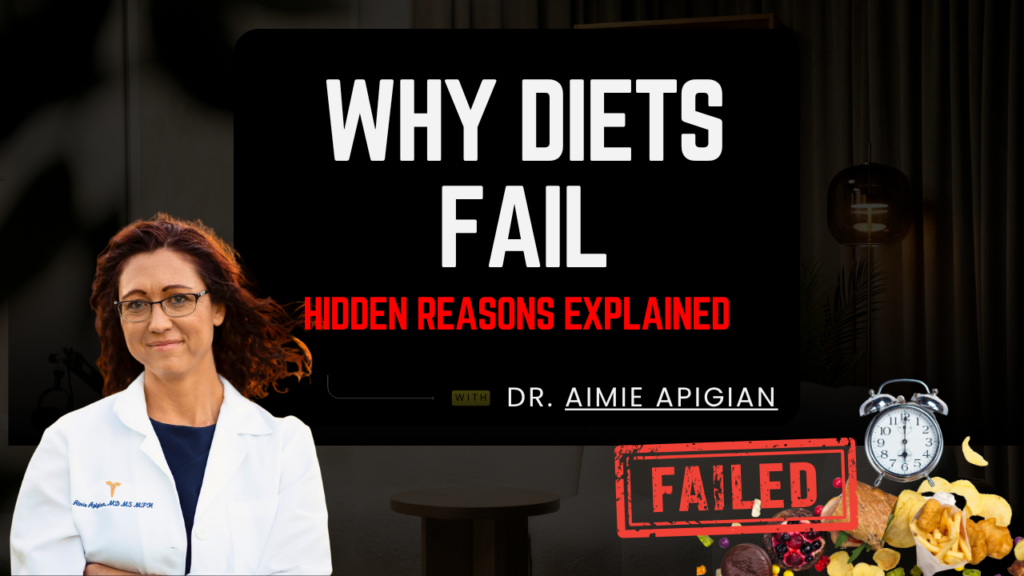
I sat down with Dr. Aimie Apigian — double board-certified physician in preventive and addiction medicine and national bestselling author of The Biology of Trauma — to talk about what is actually happening in your body when a craving hits, and why logic checks out the moment the craving gets loud enough. Watch our full conversation below.
Why this Actually Matters
Here is the reframe that changes everything: a craving is not a character flaw. It is your nervous system reporting data.
Dr. Apigian puts it plainly — when you have a craving, your body is saying, “I need something that I don’t have.” The food, the texture, the timing, none of it is random. Spicy and crunchy foods activate nerve endings and trigger a mild adrenaline response, which is exactly what an exhausted nervous system reaches for when it needs to feel alert. Soft, sedating foods — the ice cream, the bread, the pasta — bind opiate receptors that are concentrated not only in your pain centers but heavily in your gut, where a great deal of fear and overwhelm physically lives. Your body is not malfunctioning when it reaches for these foods. It is doing exactly what it was built to do: find the fastest available relief from something that feels unbearable.
This is the detail most nutrition advice skips entirely. There is a measurable point — Dr. Apigian calls it the critical line of overwhelm — past which logic simply goes offline. Below that line, you can reason with yourself, weigh consequences, make a different choice. A skilled nutritionist can help you build tools for exactly that zone. Above the line, there is no negotiating. There is only the will to survive, and that will is stronger than any meal plan, any tracking app, any amount of self-discipline you have been told you are lacking.
This is precisely why “common doesn’t mean normal” matters here. It is common to feel ashamed after eating. It is common to label foods good or bad. It is common to think you just need more self-control. None of that makes it true, and none of it is where healing starts.
The Mistakes most people Make
Mistake one: treating cravings as a willpower problem. If there is a survival logic driving the craving — if some part of you genuinely believes this food is the only available relief — no amount of reasoning will out-argue that. Trying harder, downloading another app, or relying on sheer discipline is fighting biology with logic, and biology wins every time past that critical line.
Mistake two: labeling foods “good” or “bad.” This sounds harmless. It is not. The moment you eat a “bad” food, the label transfers to you — you become the bad person who ate it. That shame spiral does not make you eat less of the food. It makes you reach for more of exactly the thing that helps numb the shame, because now you have two layers of pain to escape instead of one.
Mistake three: white-knuckling through it, then punishing yourself when it does not work. Dr. Apigian has lived this herself, and she is direct about it: after a hard therapy session, she would come home and find herself working through an entire tub of ice cream and brownies, wanting nothing more than to zone out and avoid connecting with anyone, including herself. Beating herself up over the pattern only made the emotional eating worse. The part of you driving the craving is not being defiant. It is terrified, and it has decided this food is what keeps you safe. Punishing a terrified part of yourself does not calm it down — it escalates it.
None of these are intelligence problems. You are not missing information that other people have. You are missing a nervous system that has learned to feel safe without reaching for food first — and that is a skill, not a personality trait, which means it can be taught.
Bonni's Clinical Judgement
Start here, in this order, because sequence matters more than most people realize.
First, before you eat the craved food, ask one question:
What do I hope this will do for me? Not why am I hungry — what am I hoping this gives me? Am I hoping it wakes me up? Calms me down? Makes me feel less alone for the next ten minutes? You are not trying to talk yourself out of eating. You are gathering information about what your nervous system is actually asking for, because that is the only way to eventually meet the real need instead of the substitute. Keep a one-line note of the answer each time — patterns surface fast.
Second, retire the words “good” and “bad” as food categories, starting today.
Replace them with neutral, functional language: foods that support your energy and foods that do not, foods you are choosing and foods you are reacting to. This single language shift removes the shame layer that keeps the craving cycle running.
Third, build felt safety before you try to change the behavior.
This is the step almost everyone skips, and it is why New Year’s resolutions fail at the rate they do — roughly 80 percent are abandoned within the first week, not from lack of motivation, but because the underlying survival programming was never addressed. Five minutes a day of a grounding practice — feet on the floor, slow exhale longer than your inhale, naming one thing in the room you can see, hear, and touch — done consistently, teaches your body that calm is available without food.
Fourth, do not do this alone.
If you have spent years trying to white-knuckle your way past cravings, one-on-one nutrition coaching gives you something a generic meal plan cannot: a Registered Dietitian Nutritionist in Sarasota who looks at your specific triggers, your biology, and your history, and builds a plan around the actual root cause instead of the symptom on your plate. This matters even more during perimenopause and menopause, when shifting hormones intensify cravings and make stubborn midsection weight harder to reverse with food rules alone — which is exactly why a cookie-cutter diet so often fails people in this stage of life. A licensed dietitian who understands both the biology and the behavior pattern can shorten that timeline considerably, often within a few consistent monthly sessions.
bONUS TIPS AND fAQs
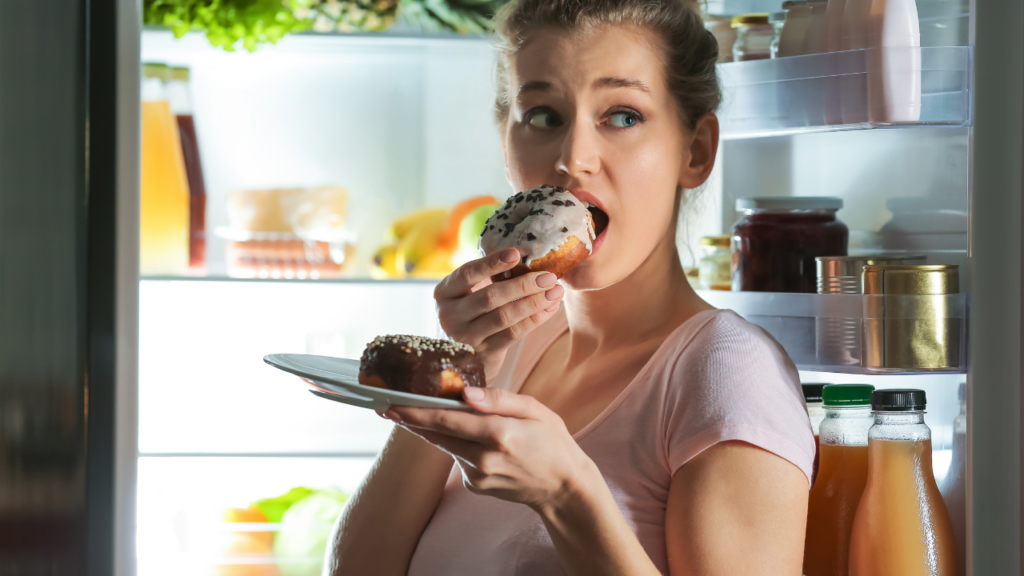
Is emotional eating the same thing as having an eating disorder? Not necessarily. Emotional eating is a spectrum, and most people who experience it never meet clinical criteria for a diagnosed eating disorder. That said, if food is your primary coping tool for distress, it is worth working with a dietitian or therapist to understand the pattern, regardless of where you fall on that spectrum.
Why do I crave the exact same comfort food every time I am overwhelmed? Because your brain has already tested it and confirmed it works. If a food did not reliably numb or soothe, your brain would not keep offering it as an option. The specificity is a clue, not a coincidence — pay attention to what you reach for and when.
Can willpower ever help with cravings? Yes, but only below the critical line of overwhelm. Willpower is a tool for everyday decision fatigue, not for moments when your nervous system has concluded it needs this food to survive. Knowing which kind of moment you are in changes which tool actually works.
Does menopause make cravings worse? Often, yes. Hormonal shifts during perimenopause and menopause can lower your tolerance for stress and intensify cravings, particularly for foods that spike blood sugar quickly. This is biology, not a loss of discipline, and it is one more reason generic diet advice tends to fail women in this stage of life.
Key Takeaways
- Cravings are your nervous system reporting an unmet need, not evidence of weak willpower.
Past the critical line of overwhelm, logic and discipline genuinely stop working — survival biology takes over instead.
Labeling foods “good” or “bad” creates shame that drives more of the exact eating pattern you are trying to stop.
Felt safety, not behavior change, is the first and most skipped step in breaking a craving cycle.
Perimenopause and menopause can intensify cravings through hormonal shifts, which is why generic diet advice often fails midlife women.
A Registered Dietitian Nutritionist who understands trauma biology can build a plan around your actual root cause, not just another restriction.
Ready to stop Yourself
You do not need another meal plan. You need a clinician who understands why the cravings are there in the first place, then builds a plan around your actual biology. If you are ready to stop white-knuckling and start working with your nervous system instead, this is exactly the work we do together.
Get the chance to work with Dr. Aimie!
Get connected with her on these platform
- Website: https://biologyoftrauma.com/
- LinkedIn: https://www.linkedin.com/in/
dr-aimie-apigian - YouTube: https://www.youtube.com/c/
DrAimieApigian - Instagram: https://www.instagram.com/
draimie/ - Facebook: https://www.facebook.com/
aimie.apigian/