You have probably seen the ads. A clinic promises 100 million stem cells. A post says one infusion will erase your knee pain, your brain fog, maybe your age. And since July 2025, Florida law has made it easier for physicians to offer stem cell therapies the FDA has not approved.
If you live with chronic pain, a slow-healing injury, or a diagnosis that has worn you down, those ads speak directly to you. That is exactly why they deserve a closer look. The people most willing to try anything are often the people most at risk of spending tens of thousands of dollars on something that does not work, or worse.
I wanted real answers, so I sat down with Dr. Paul Anderson on Healthy Rebels Speaks Out. He has spent more than 30 years treating chronic pain and complex medical cases, and he now uses stem cells and exosomes in his practice. What surprised me most was how often he talked patients out of stem cells. His first rule was the same one I live by as a dietitian: no single treatment replaces the foundation.
Watch our full conversation below, then read on for what to ask before you spend a dollar.
[INSERT VIDEO EMBED — YouTube URL: [YOUTUBE URL]]
Why This Actually Matters
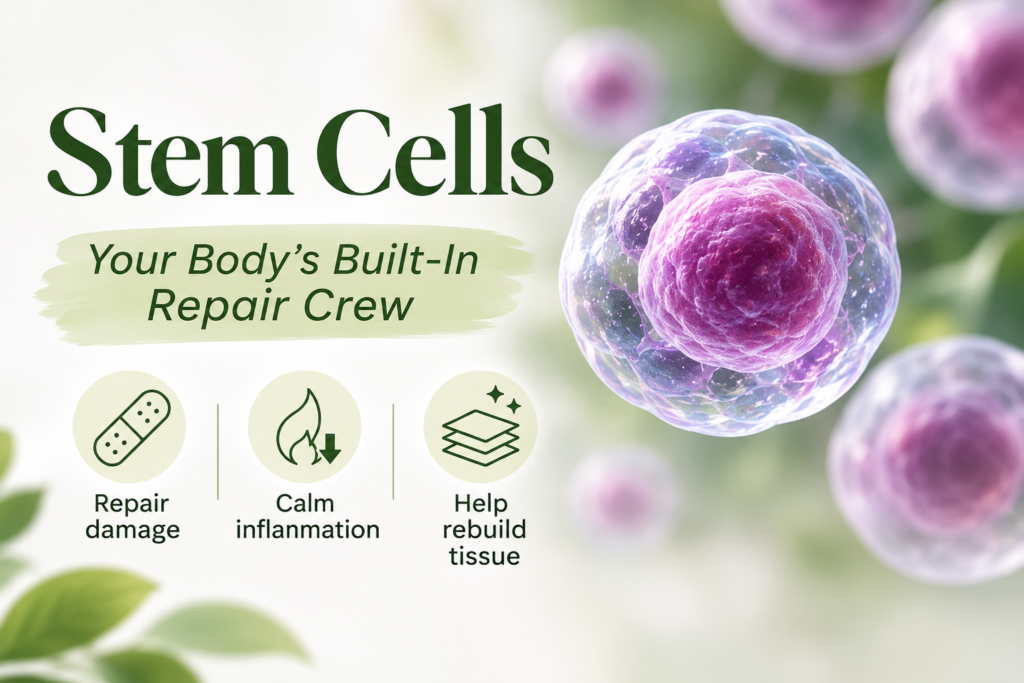
Your body already runs a repair system. Dr. Anderson described it in two layers. Local stem cells live in your tissues and handle the daily upkeep, like a house cleaner doing the dusting and the laundry. When something bigger happens, such as an injury, a stroke, or chronic inflammation, stem cells from your bone marrow move into your bloodstream, find the damage, and go to work. They increase blood flow, calm inflammation, and help rebuild tissue.
The catch is that this system slows down with age. Think about how fast a cut healed when you were 8, and how long a bruise lingers now. Our modern lifestyle, with processed food, constant screens, indoor light, and little movement, does not help.
That explains the appeal of adding stem cells from outside. But the rules around that are less settled than the ads suggest.
At the federal level, the FDA has approved very few stem cell products. Cord blood products for certain blood disorders are approved, and in December 2024 the FDA approved Ryoncil, the first mesenchymal stromal cell therapy, for children with a serious complication after bone marrow transplant. Beyond those uses, the FDA considers most stem cell, Wharton’s jelly, cord blood, and exosome products marketed by clinics unapproved. It has received reports of blindness, tumors, and infections linked to them.
Florida took a different path. Its 2025 law lets licensed medical and osteopathic physicians offer non-FDA-approved stem cell therapies for three areas only: orthopedics, wound care, and pain management. The cells must come from an FDA-registered facility accredited by one of four named organizations. The physician must receive a post-thaw report showing the cells are alive before using them. Patients must sign a consent form stating the therapy is not FDA approved, and every ad must carry that notice too. Several legal analysts note that the state law and federal law do not fully line up, so this area may keep changing.
The Mistakes Most People Make
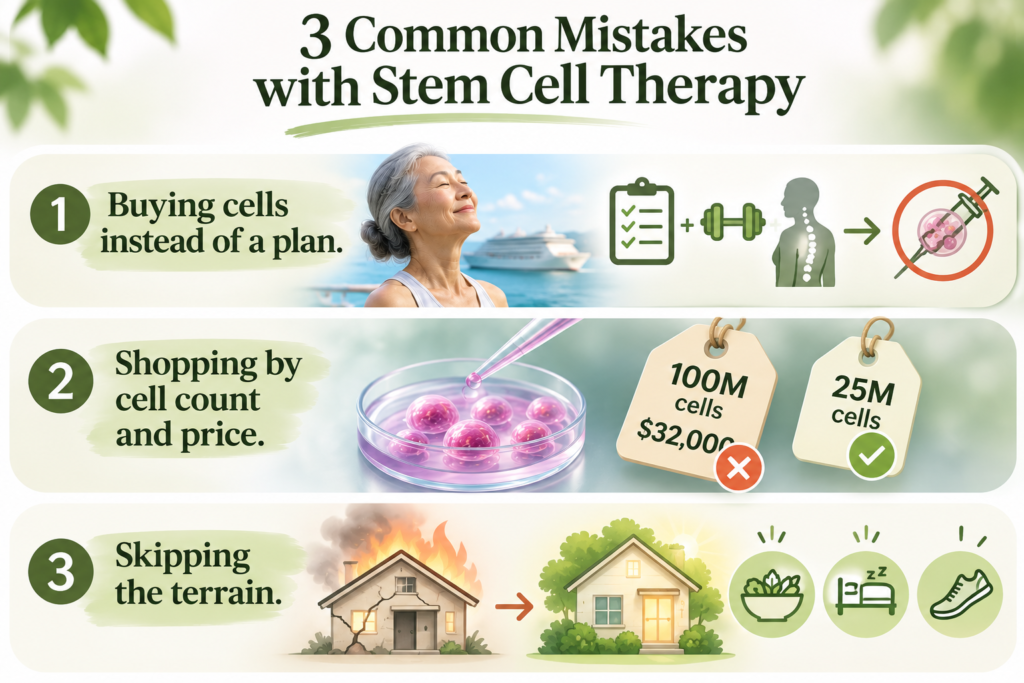
None of these mistakes come from carelessness. They come from being in pain, being tired of waiting, and trusting a confident ad.
Mistake one: buying cells instead of a plan. Dr. Anderson’s mentor told him, “You need to be a good doctor first.” He told me about an 82-year-old yoga teacher who came in with hip and knee pain, ready for stem cells. He sent her to his physical therapist and chiropractor for four weeks first. She came back pain-free, skipped the stem cells, saved about $10,000, and left on a cruise around the world. If a provider offers you cells without asking why you have the problem, keep looking.
Mistake two: shopping by cell count and price. Big numbers sell. Dr. Anderson described a prospective patient with MS whom a clinic quoted $32,000 for 100 million cells. To reach numbers that high, labs grow cells in culture through multiple rounds, and he believes repeated expansion raises the risk of abnormal cells. He caps his own doses at about 25 million cells, a number he can reach without expanding. He also told me about a patient who spent $14,000 offshore with no improvement. Outside the U.S., you often cannot verify what you received, or whether the cells were even alive. When his lab partner tested products from eight labs after thawing, he said six contained only dead cells.
Mistake three: skipping the terrain. Stem cells work in the environment you give them. If you eat poorly, sleep badly, and never move, you are asking a repair crew to rebuild a house that is still on fire.
Five Labs Worth Asking About
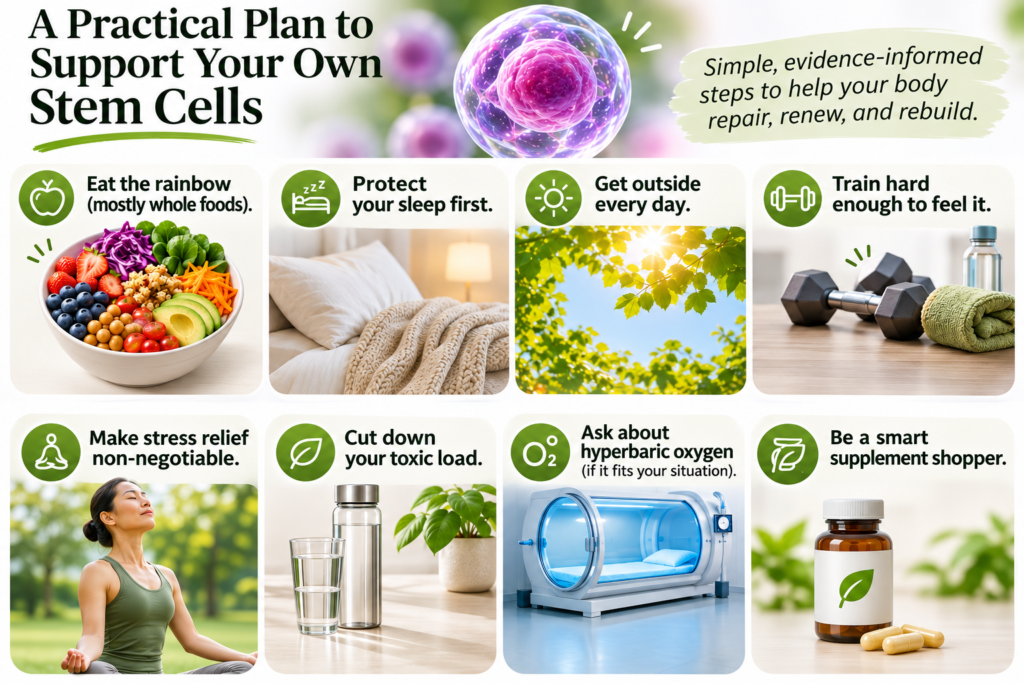
The most useful part of this conversation is that the things that support your own stem cells overlap almost completely with what I recommend to clients every day. Here is where I would start.
Eat the rainbow, mostly from whole foods. Dr. Anderson put it simply: a wide variety of colorful fruits and vegetables delivers a wide variety of phytonutrients, and no single “superberry” beats variety. I apply the 80/20 rule here. Focus on what you do most often, not on perfection.
Protect your sleep first. For patients with chronic pain or brain conditions, sleep is the first thing Dr. Anderson treats, before exercise and before stem cells. Poor sleep keeps inflammation high and recovery low.
Get outside every day. Natural light, even on a cloudy day, does what indoor LED lighting cannot. At night, switch your phone and computer to a warm, low-blue-light setting.
Train hard enough to feel it. High-intensity strength training and intervals send a strong signal to your body to adapt and rebuild. You need some discomfort, whether that means getting out of breath or feeling the burn in a muscle, because that discomfort is the signal. If pain keeps you from exercising, start where Dr. Anderson starts: sleep, pain relief, then a gradual return to movement with a qualified therapist.
Make stress relief non-negotiable. Meditation, yoga, and tai chi lower inflammation and help your body shift from stress mode into repair mode.
Cut down your toxic load where you can. Filter your water and store it in glass or stainless steel instead of plastic. Indoor air matters too, since new flooring and furniture release chemicals into your home.
Ask about hyperbaric oxygen if it fits your situation. A 2006 University of Pennsylvania study found that circulating stem and progenitor cells rose eightfold over a course of 20 hyperbaric treatments. That is one of the better-documented ways to mobilize your own cells.
Judge supplements by the evidence on the finished product. Dr. Anderson is testing a botanical supplement, StemRegen Release, that its maker says raises circulating stem cells. He says it is early days, and he will know more in about six months. Before you buy any product like this, I ask five questions. What was measured, in whom, compared with what, and for how long? Does the evidence fit this product and your goal? What problem is the formula designed to solve? What is in it, and how was it tested? And how do you know it keeps its claimed properties until the expiration date?
If you want help building this foundation, that is exactly what one on one nutrition coaching in Sarasota looks like with me. As a registered dietitian nutritionist in Sarasota, I [build the plan around your labs, your goals, and your life]([LONDON WELLNESS SERVICES URL]).
Bonus Tips & FAQs

What should I ask a provider before paying for stem cells? Ask whether they will give you a full program or only an injection. Ask which lab supplies the cells, which organization accredits it, and whether you can see the post-thaw viability report. In Florida, also confirm your condition falls under orthopedics, wound care, or pain management, and expect a signed consent form that states the therapy is not FDA approved.
Are stem cells safe? Dr. Anderson reports no side effects in his practice, using U.S.-sourced umbilical cord cells from an accredited lab. At the same time, the FDA has documented serious harms from unapproved products elsewhere. The source, the lab, and the provider make all the difference.
What are exosomes? They are tiny packets stem cells release to send signals to other cells. They are not cells themselves. Some providers now offer them alone or alongside stem cells.
What about peptides like BPC-157? Dr. Anderson uses an oral form for gut healing. I have used it myself and liked the results. Know the regulatory picture, though. BPC-157 remains unapproved, human research is very limited, and while an FDA advisory panel voted 8 to 6 in July 2026 to allow compounding, the FDA has not adopted that recommendation. It is also banned in competitive sport. Talk with a qualified provider first.
Key Takeaways
-
- Your body has its own stem cell repair system, and it slows with age and modern lifestyle.
- Florida’s 2025 law allows non-FDA-approved stem cell therapy only for orthopedics, wound care, and pain management, with strict lab and consent rules.
- A good provider asks why you have the problem before offering cells, and sometimes the answer is rehab, not stem cells.
- Bigger cell counts and lower prices are not better; ask for the lab, its accreditation, and the post-thaw viability report.
- Sleep, daily outdoor light, colorful whole foods, hard training, and stress relief all support your own repair system.
- No treatment replaces the terrain: the foundation determines what any therapy can do.
Healthspan is not built with one injection. It is built with what you do every day, and the right support when you need more. If you want a partner in building that foundation, I would love to talk.